Planned Development - A Complete Guide to Forecasting Market Shifts Before They Happen
In competitive industries like retail, restaurants, commercial real estate, and franchising, being six to twenty-four months ahead of the market is not a luxury. It is a strategic necessity.
24th April 2026 - 3 min read
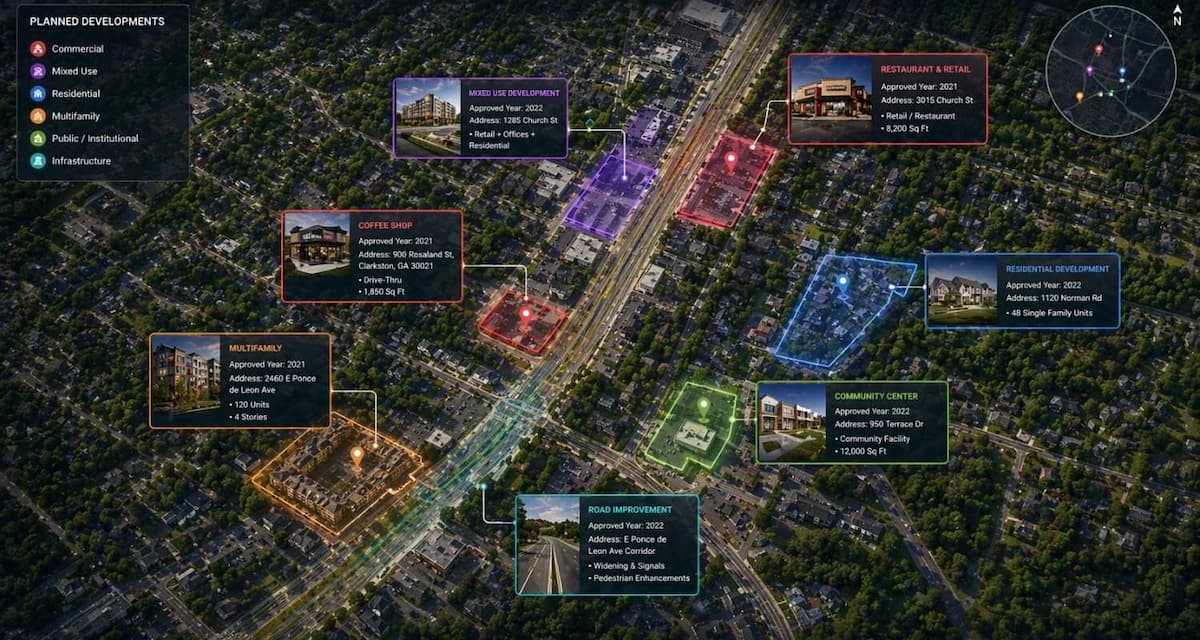
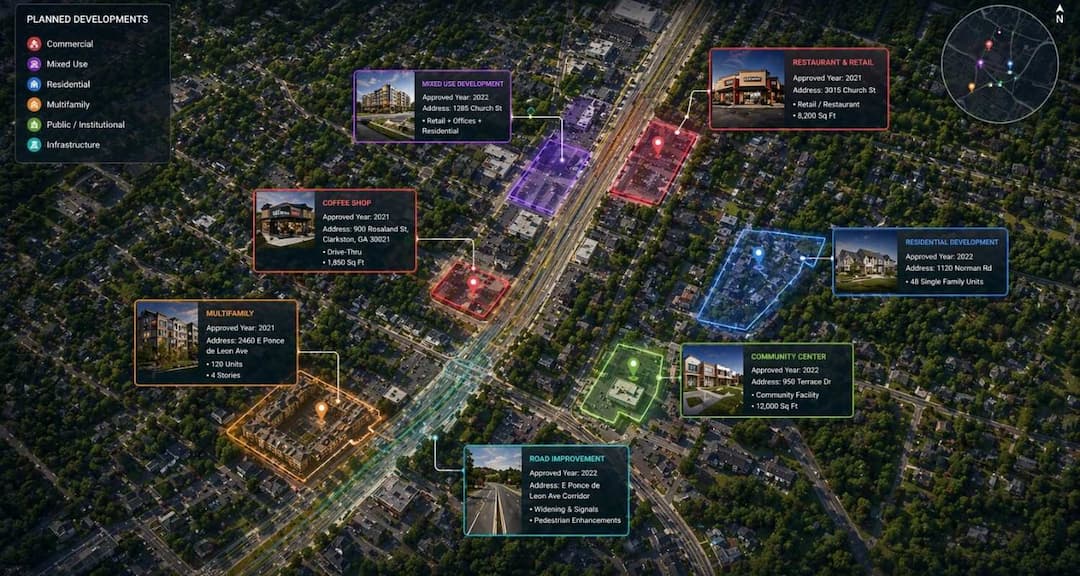
What Is Planned Development
Every city, suburb, and emerging corridor is constantly in motion. New housing communities break ground. Mixed-use developments receive permits. Retail corridors expand. Office parks attract new tenants. These changes reshape foot traffic patterns, population density, spending power, and competitive dynamics, often years before the first customer walks through a door.
Planned Development Intelligence is the practice of tracking, analyzing, and acting on approved or permitted development projects before they are built. It gives businesses, investors, and commercial real estate professionals a forward-looking view of how a market is going to change, not just how it looks today.
MapZot.AI's Planned Development tool sits at the intersection of location data, demographic forecasting, and market intelligence. It gives you early access to approved development activity in any trade area so you can anticipate where customer demand will grow, where competitors will emerge, and where the highest-value expansion
Why Planned Development Data Is a Competitive Advantage
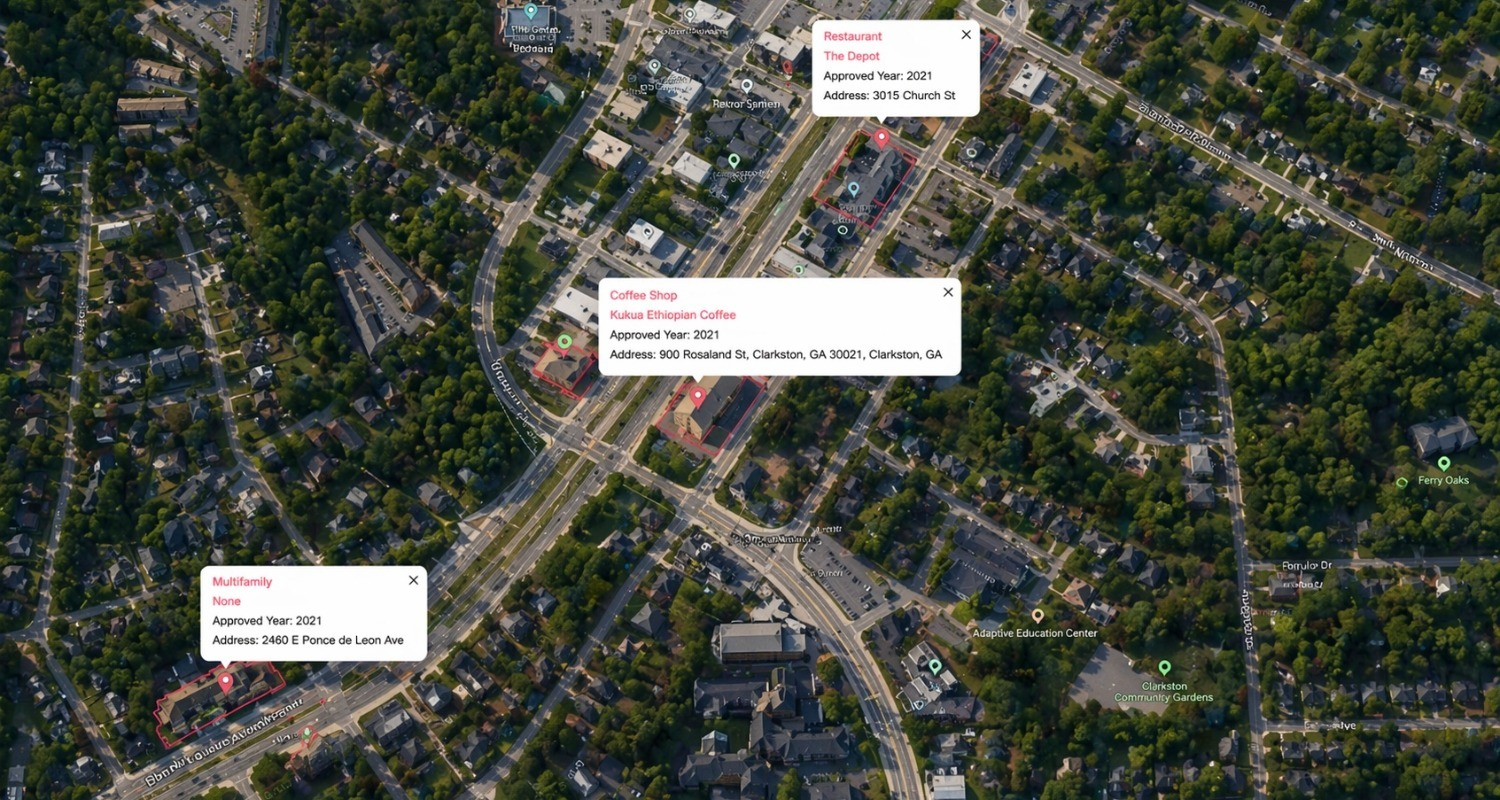
Most location intelligence tools tell you what has already happened, where customers are shopping today, where competitors are operating right now, what revenue a store generated last quarter. This backward-looking data is valuable. But it only tells half the story.
The businesses that win in competitive markets are the ones that act on what is coming, not just what is.
Planned development data gives you visibility into the future state of any market:
- Population shifts driven by new housing. When a 1,200-unit apartment complex or a 400-home subdivision is approved in a corridor, it is a signal that thousands of new residents with real spending power are on their way. Businesses that identify these corridors early can secure premier locations before rents spike and before competitors take notice.
- Traffic pattern changes driven by new infrastructure. A new interchange, expanded arterial road, or mixed-use development anchored by a major national retailer will fundamentally alter the traffic flows in its vicinity. Knowing this in advance allows you to re-evaluate your existing trade areas and identify where new demand is being created.
- Competitive threats from incoming retailers and operators. When a competitor receives approval to open in your market, you have a window of time to reinforce your own market position whether that means strengthening your existing location's performance, accelerating a planned opening nearby, or adjusting your pricing and marketing strategy before their doors open.
- Emerging hotspots before they are priced in. The best locations in tomorrow's growth corridors are available today at yesterday's prices. Once development activity becomes visible to the broader market, lease rates rise, competition increases, and the window for advantageous positioning narrows significantly.
- Planned Development Intelligence compresses the time between market signal and strategic action. That compression is where competitive advantage lives.
The Cost of Acting Without Planned Development Insights
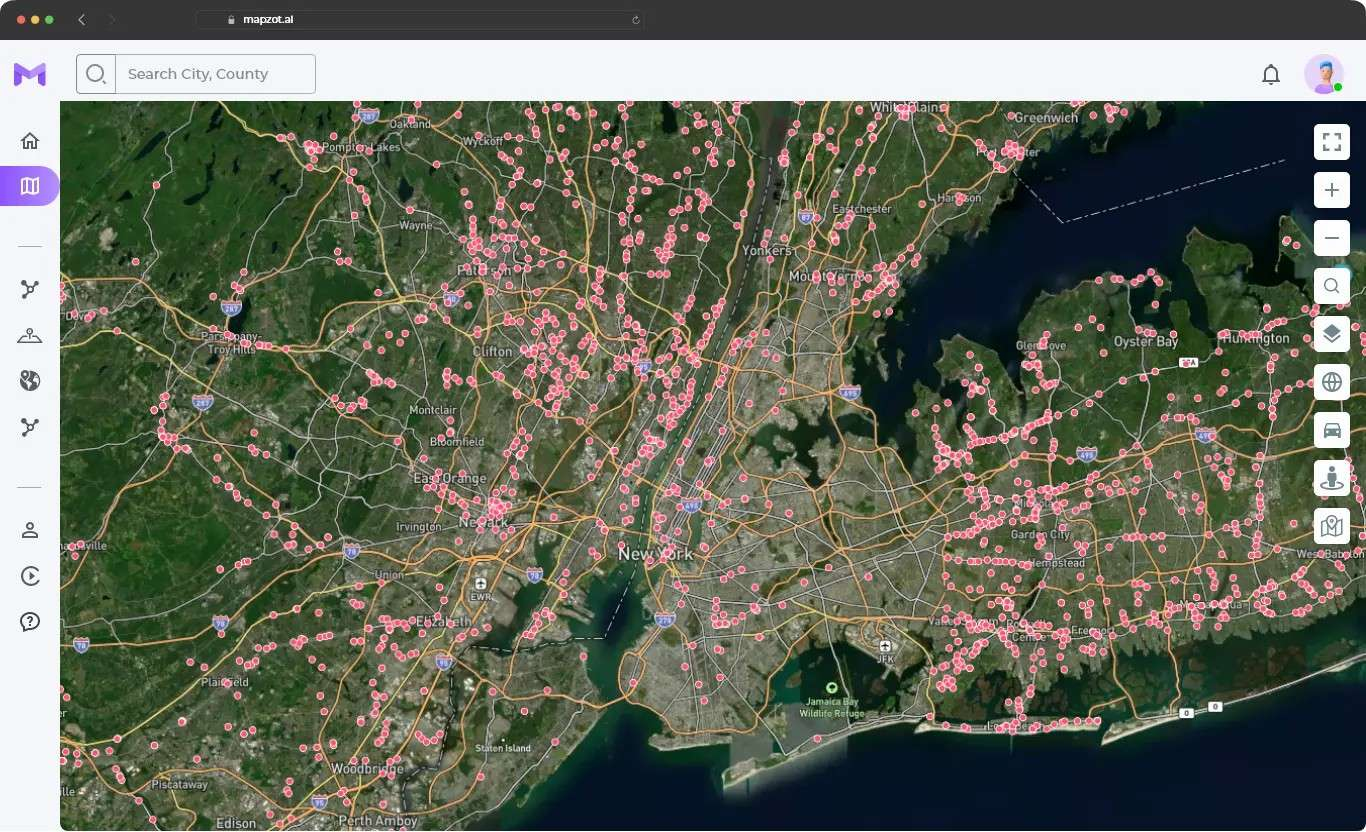
Businesses that rely on reactive decision-making, responding to market changes after they have already occurred pay a measurable price.
- Missed expansion windows. The prime location in an emerging growth corridor goes to the brand that spotted the opportunity first. By the time market data reflects the growth that planned development was signaling, that location is gone, and the next-best alternative comes at a higher cost and lower traffic advantage.
- Unplanned cannibalization. A franchise group approves a new location without knowing a competitor approved a nearly identical format two miles away six months ago. The result is a weaker-than-projected performance from day one, a problem that was preventable with access to planned development data.
- Reactive lease negotiations. Signing a long-term lease without understanding the development pipeline in a trade area is a significant risk. A corridor that appears stable today may be transforming into a high-traffic, high-demand market in eighteen months meaning you could be locked into below-market terms. Alternatively, planned closures or commercial downturns in a market could signal that a long-term commitment is unwise.
- Slow response to competitive threats. When a major competitor opens in your market, the time to respond is before they open, not after. Planned development data gives you the lead time to adjust your strategy, strengthen your marketing, update your trade area positioning, and potentially accelerate your own nearby openings.
The common thread across all of these scenarios is timing. Planned development data does not just give you better information it gives you better information earlier, when it has the highest strategic value.
Key Use Cases by Industry
Planned Development Intelligence serves a wide range of industries and decision-making contexts. Here are the most impactful applications.
Retail Chains and Franchise Networks
- For multi-unit retail operators, planned development data is the foundation of proactive market entry strategy. When a new residential development is approved in a suburban corridor, it is a signal that household density — and therefore retail demand — is about to increase. Retailers who identify these corridors early can secure A-grade locations before the competition, negotiate favorable lease terms, and time their openings to coincide with the population influx. Conversely, planned development data helps franchise networks avoid market saturation by identifying corridors where multiple franchisees are converging on the same trade area — enabling early intervention before cannibalization erodes system-wide performance.
Restaurants and Coffee Chains
- Restaurant site selection is particularly sensitive to traffic patterns, population density, and the competitive landscape. A new quick-service or fast-casual entrant entering your market can meaningfully shift customer traffic — and you may have twelve to eighteen months of advance notice if you are monitoring planned development. Coffee chains and breakfast-daypart operators benefit specifically from new office developments and residential communities that create predictable morning commute demand. Planned Development data helps operators align new store openings with these emerging demand corridors rather than discovering them after competitors have already moved in.
Commercial Real Estate Professionals
- CRE brokers, developers, and asset managers use planned development data to identify markets before they heat up, evaluate the risk and opportunity profile of specific corridors, and provide clients with forward-looking market intelligence that distinguishes their advisory services. For leasing professionals, planned development data informs tenant mix recommendations for retail centers — identifying incoming residential populations whose spending profile aligns with specific tenant categories. For investors and developers, it surfaces acquisition targets in corridors where upcoming development will drive demand and property value appreciation.
Franchise Owners and Operators
- Franchisees operate in a particularly high-stakes version of the location decision — they are committing to a specific geography under a long-term agreement with limited flexibility to pivot. Planned development data helps franchise owners validate that the trade area they are entering has a growth trajectory that supports the performance targets built into their pro forma. It also helps identify early warning signs of market saturation — when a competitor brand or even another franchisee in the same system is planning a nearby opening that could compromise trade area performance.
Banking, Finance, and Real Estate Investment
- Financial institutions and real estate investment firms use planned development intelligence to assess the long-term trajectory of markets where they are making lending decisions or capital allocations. A corridor with significant approved residential and commercial development has a fundamentally different risk profile than one without it. Planned development data contextualizes investment decisions with forward-looking market signals that traditional financial underwriting often misses.
Civic and Economic Development Agencies
- Local governments and economic development agencies use planned development intelligence to attract businesses to growth corridors, understand the service demands that incoming development will create, and communicate market opportunity to potential retail and commercial tenants. When a city can show a retailer not just who lives in a corridor today but where approved development is pointing that corridor over the next three years, the economic development conversation becomes far more compelling.
How to Read and Act on Planned Development Data
Understanding what planned development data is telling you is one thing. Knowing how to translate those signals into strategic action is another. Here is a practical framework.
- Step 1: Identify the development type and scale. Not all development signals carry equal weight. A 500-unit mixed-use residential development with ground-floor retail anchors in a high-income corridor is a fundamentally different signal than a single-family subdivision in a stable suburban market. Assess the type, scale, and demographic profile of the development to calibrate how significant the market change will be.
- Step 2: Map the trade area impact. Where will the development's residents, employees, and visitors generate demand? Use MapZot.AI's trade area analysis tools to define the primary and secondary trade areas that the planned development will influence. Overlay your existing locations, if any, to understand whether this represents an expansion opportunity or a potential cannibalization risk.
- Step 3: Assess the competitive response. Are competitors already tracking this development? Check the competitive landscape in and around the emerging hotspot using MapZot.AI's Mobilytics and competitor intelligence data. If the corridor is already attracting competitor applications and permits, the window for first-mover advantage may be narrowing.
- Step 4: Model the revenue potential. Use AccuSite.AI's sales forecasting to project what a new location in this corridor could generate — incorporating the demographic enrichment from the planned development rather than relying solely on current market conditions. This forward-looking pro forma is what makes the decision defensible to stakeholders.
- Step 5: Set a decision timeline. Planned development has a timeline built in — permit approvals, construction phases, and opening dates. Align your location decision timeline with the development's expected delivery so your opening coincides with peak demand generation rather than arriving too early or too late.
- Step 6: Monitor the signal over time. Development timelines change. Projects get delayed, modified, or cancelled. Set up monitoring within MapZot.AI so that if the planned development status changes, your expansion strategy can adjust accordingly rather than proceeding on assumptions that are no longer valid.