The automotive aftermarket industry is entering a new era of expansion, but the brands winning in 2026 are no longer relying on instinct alone.
From rising vehicle ownership and aging cars to increased demand for maintenance services, auto parts retailers across the United States are rapidly scaling operations. Yet one major challenge remains:
The 2026 U.S. Auto Parts Retail Market Snapshot
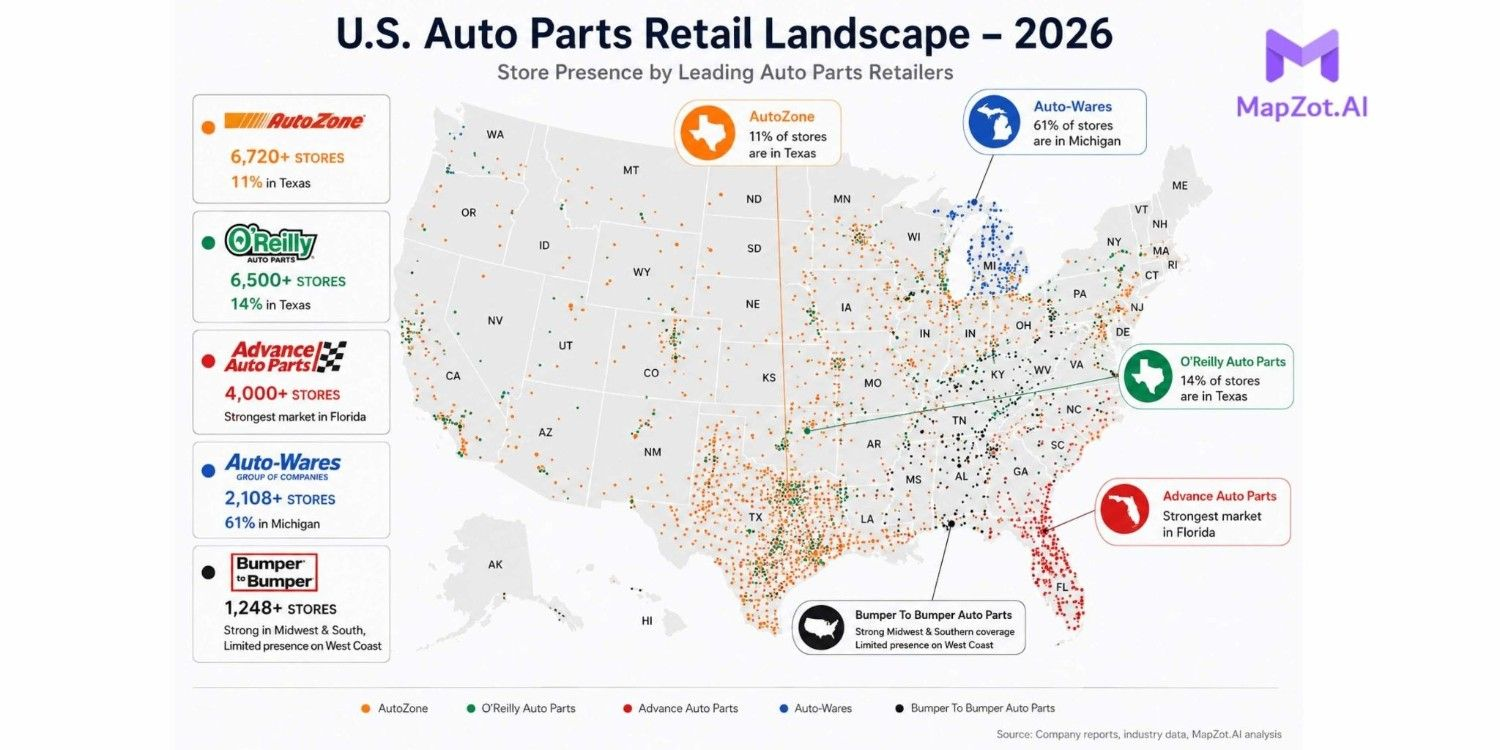
The numbers reveal a fascinating story about regional dominance and expansion strategies:
AutoZone operates over 6,720 stores across the U.S., with nearly 11% concentrated in Texas.
O'Reilly Auto Parts has expanded to 6,500+ locations, with Texas accounting for approximately 14% of its footprint.
Advance Auto Parts manages over 4,000 stores, with Florida emerging as its strongest market
Auto-Wares has built a highly concentrated regional network, with more than 60% of its locations in Michigan
Bumper To Bumper Auto Parts continues to maintain strong Midwest and Southern coverage but shows limited West Coast penetration
These aren’t just store counts.
They’re signals of where demand exists, where competition is intensifying, and where future growth opportunities may still be untapped.
Why Automotive Brands Are Turning to AI-Powered Site Selection
The automotive retail industry has become increasingly data-driven.
In the past, expansion decisions often relied on broker recommendations, intuition, or surface-level demographic reports. Today, brands are leveraging AI and mobility intelligence to make far more precise decisions.
Modern automotive retailers need answers to questions like:
Which markets are oversaturated with competitors?
Where is vehicle ownership growing fastest?
Which trade areas have high commuter traffic?
Where are customers leaking to competitors?
Which regions have strong aftermarket spending potential?
How far are customers willing to travel for auto parts and repair services?
Texas: The Auto Parts Expansion Battleground.
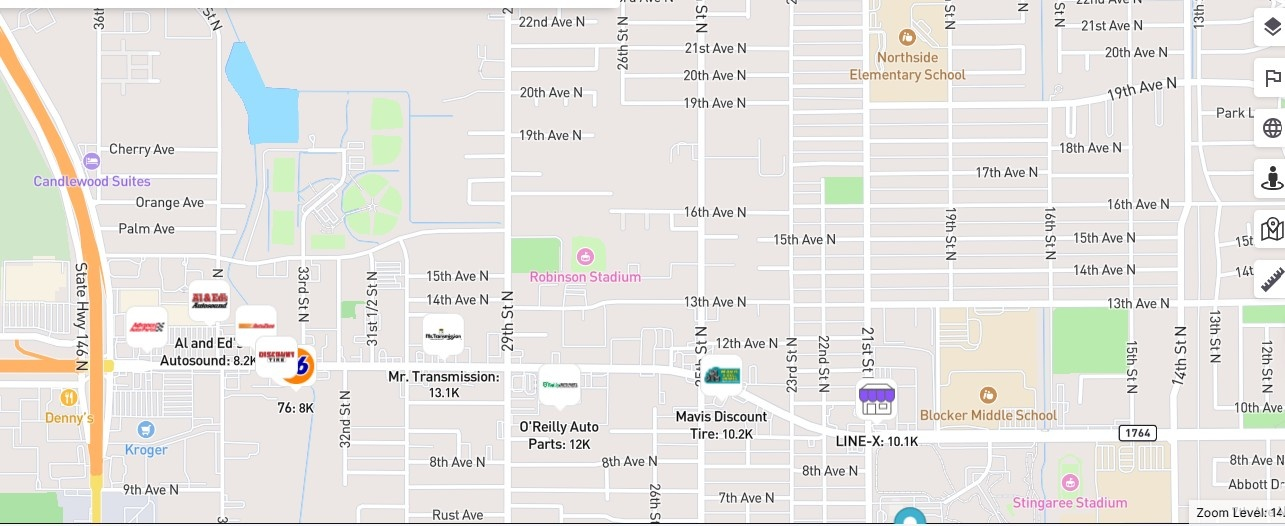
One of the clearest trends in 2026 is the dominance of Texas in automotive retail expansion.
Why?
Several macroeconomic and demographic factors make Texas one of the strongest automotive retail markets in the country:
1. Rapid Population Growth
Cities like Dallas, Houston, Austin, and San Antonio continue to see major population inflows, increasing vehicle ownership and service demand.
2. Car-Dependent Infrastructure
Texas remains heavily vehicle-reliant, driving consistent aftermarket demand for maintenance, replacement parts, and accessories.
3. Logistics and Distribution Advantages
Retailers benefit from central distribution access, making inventory movement and fulfillment faster and more cost-efficient.
4. Expanding Suburban Markets
Emerging suburban trade areas present strong opportunities for new store development with lower competition compared to dense urban cores.
For automotive brands, this creates a critical question:
Is your business entering the right Texas market, or entering a saturated one?
Oversaturated vs Underserved Markets
One of the biggest mistakes automotive retailers make is confusing high demand with opportunity.
A market may show strong vehicle traffic and consumer demand, but if multiple competitors already dominate the area, profitability becomes significantly harder.
Using AI-powered market analysis, brands can identify:
White-space opportunities with limited competition
High-growth suburban corridors
Trade areas with underserved consumers
Regions where competitors are over-concentrated
Markets with strong long-term viability
Instead of chasing obvious locations, smarter brands are discovering hidden growth pockets before competitors do.
The Rise of Predictive Expansion Strategy
The automotive industry is increasingly shifting from reactive expansion to predictive expansion.
Rather than waiting for a market to mature, leading retailers are using mobility data, consumer behavior insights, and traffic analytics to forecast where demand will emerge next.
This includes analyzing:
Daily traffic flow patterns
Consumer visitation behavior
Competitor foot traffic
Population migration trends
Household income shifts
Vehicle density by region
Retail co-tenancy opportunities
With AI-driven analytics, expansion teams can make decisions backed by measurable market signals instead of assumptions.
The Future of Automotive Retail Belongs to Data-Driven Brands
The automotive aftermarket industry will continue evolving rapidly in 2026 and beyond.
As competition intensifies, the brands that scale successfully will be the ones using AI, mobility intelligence, and predictive analytics to guide expansion.
Because in today’s market, growth isn’t just about opening more locations.
It’s about opening the right locations