Grocery retail doesn't feel like a battlefield. It feels like a Tuesday errand. But behind every parking lot, every new store opening, and every "we're closing this location" announcement, two of the country's biggest grocers are locked in one of the most consequential retail rivalries in a decade.
On one side: Kroger, the nation's largest pure-play grocer, betting on scale, regional density, and a $1.65 billion acquisition of Giant Eagle to defend its turf. On the other: ALDI, the German discounter that's quietly become the third-largest grocery chain in America by store count, backed by a $9 billion war chest aimed at getting to 4,000 U.S. locations.
Both companies are chasing the same shopper. Neither can win with instinct alone. And that's exactly where location intelligence, real-world foot traffic, trade area, and site performance data, is separating the strategy decks from the store openings that actually work.
Here's what the data says about who's winning, why, and what it means for anyone making site selection or expansion decisions in the grocery category right now.
The State of the Grocery Wars in 2026
Grocery has always been a low-margin, high-volume game, which is exactly why market share shifts here are so telling. A few data points set the stage:
Walmart still leads U.S. grocery with roughly 21% market share, followed by Kroger, Costco, Albertsons, and Publix according to market researcher Numerator.
Kroger's market share has been declining over recent years, dropping from 9.8% to 8.5%, a slide that mirrors similar erosion at Albertsons.
Meanwhile, ALDI has become the third-largest grocer in the country by store count, trailing only Walmart and Kroger, even though its overall market share is still small relative to those giants.
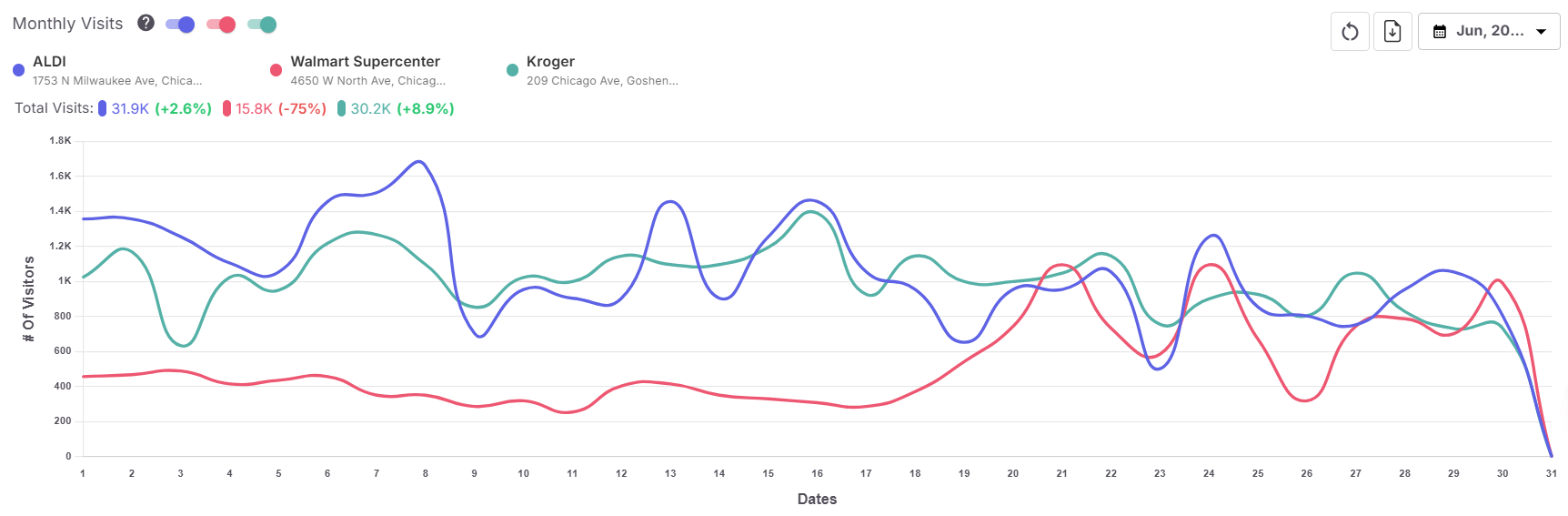
The clearest signal isn't revenue. It's feet through the door: ALDI's store visits rose 8% year over year in 2025, compared with Costco's 5.9% growth, Albertsons' 1.6% increase, Kroger's 0.8% rise, and Walmart's 0.5% growth, against sector-wide grocery traffic growth of just 3.1%.
That last stat is the one that should stop retail strategists mid-scroll. ALDI isn't just opening stores, it's pulling traffic away from everyone else at nearly triple the category average, while Kroger's existing footprint is essentially treading water.
Two Very Different Playbooks
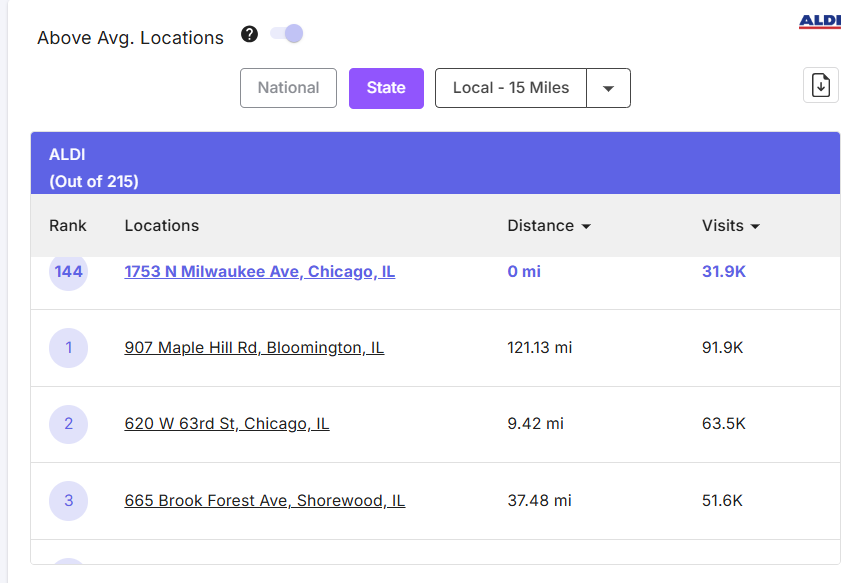
ALDI is investing $9 billion to expand its deep-discount model, targeting 4,000 compact, efficient stores built around private labels and self-service, a format designed to win on price without sacrificing margin. The rollout isn't scattershot either:
ALDI plans to open more than 180 U.S. stores in 2026, pushing its total footprint to nearly 2,800 locations by year-end.
The expansion is planting ALDI's flag in its 40th state, Maine, while kicking off a five-year plan to enter Colorado, adding 10 new stores in Phoenix, and doubling its Las Vegas footprint by 2030.
The company is also converting roughly 80 locations acquired from Southeastern Grocers, a faster, lower-risk path to shelf space than building from the ground up.
ALDI's own leadership isn't shy about the ambition: "We're trying to take market share from anyone who sells groceries," said Scott Patton, ALDI USA's chief commercial officer.
This is a company treating store count like a growth metric, not just a footprint metric, and using site selection as the primary weapon.
Kroger: Scale Through Acquisition, Not Just Construction
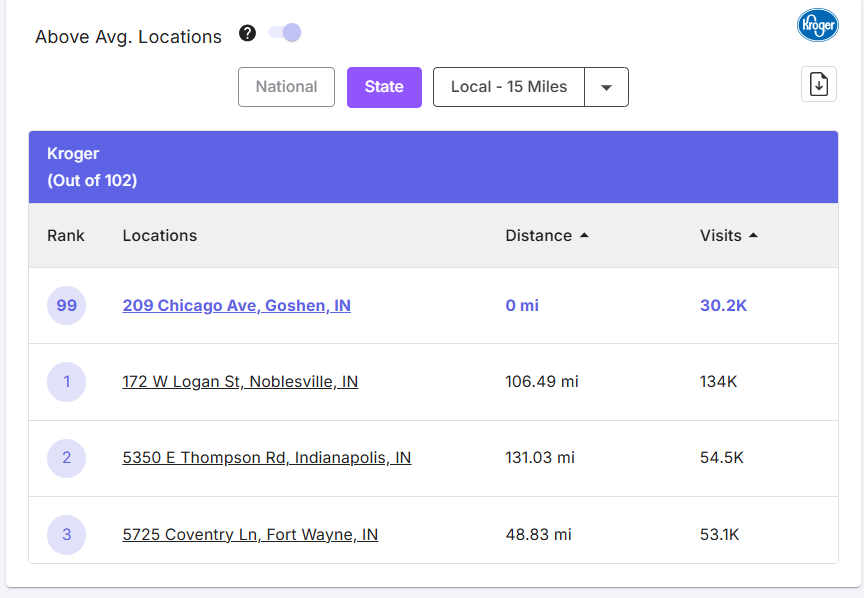
Kroger's response has been different: buy density instead of building it store by store. In 2026, the company announced it would acquire Giant Eagle, a family-owned grocer with roughly $9 billion in annual sales and 197 supermarkets plus 11 pharmacies across northern Ohio, western Pennsylvania, West Virginia, Maryland, and Indiana, for $1.65 billion.
The logic is explicitly about location, not just brand:
Kroger will gain incremental market share largely because most Giant Eagle stores sit in markets where Kroger doesn't currently have a presence, according to Telsey Advisory Group analyst Joe Feldman.
Industry analysts see the same pattern. Feldman noted that selective acquisition is the right strategy in grocery "given the difficulty in securing prime real estate locations and the time needed to open stores organically."
Kroger's new CEO, Greg Foran, a former senior Walmart executive, has been candid about why the company needed to move, saying competitors kept growing their footprint while Kroger stepped back, and that standing still on store growth simply isn't an option going forward.
The stakes are real: Kroger opened just 16 new stores but closed 50 during its last fiscal year, a net contraction at a moment when its biggest challenger is opening a new store every few days.
Analysts are split on whether the deal is enough. Some call it a "master stroke" that opens the gateway to the Eastern Great Lakes and Mid-Atlantic markets and makes it harder for competitors like Walmart to find space for large-footprint shopping centers nearby. Others are more skeptical, with retail consultant Phil Lempert arguing the acquisition's financing structure leaves little capital to fund the in-store turnaround Foran has promised.
The Bottom Line
Kroger is defending scale. ALDI is attacking with speed and price. Both strategies live or die on the same variable: whether the physical locations they're fighting over actually deliver the shoppers each side is counting on.
That's the layer most competitive analysis misses, the gap between a strategy announced in a press release and a strategy validated by actual foot traffic, trade area capture, and site-level performance. Grocery is simply the clearest example right now of a much broader truth in retail: the winner isn't decided in the boardroom. It's decided at the curb.
MapZot.AI helps retailers, investors, and analysts see that layer clearly, turning real-world location and foot traffic data into the kind of site selection, trade area, and competitive intelligence that separates a good expansion strategy from an expensive one. If you're tracking category shifts like the grocery wars, or making your own site selection and investment decisions, that's exactly the kind of visibility we're built for.