Buc-ee's is on a tear. From 12 states in 2024, the Texas-born travel center giant is aggressively targeting 20+ states by 2027, with each new store representing a $50–80M investment and hundreds of local jobs. MapZot.AI breaks down the data behind one of American retail's most ambitious expansions.
The Expansion Playbook: Destination Over Convenience
Most convenience stores compete on proximity. Buc-ee's competes on experience. Founded in 1982 in Lake Jackson, Texas, the chain spent its first four decades building a cult following in its home state before opening its first out-of-state location in Alabama in 2019. Since then, the pace of expansion has accelerated dramatically.
The formula is deceptively simple: a massive footprint (typically 74,000 sq ft larger than most big-box retailers), 120 fueling positions, an immaculate restroom experience, made-to-order food, and wall-to-wall Texan merchandise. The result is a travel center that functions less as a pit stop and more as a destination in its own right.
New Markets: A State-by-State Breakdown
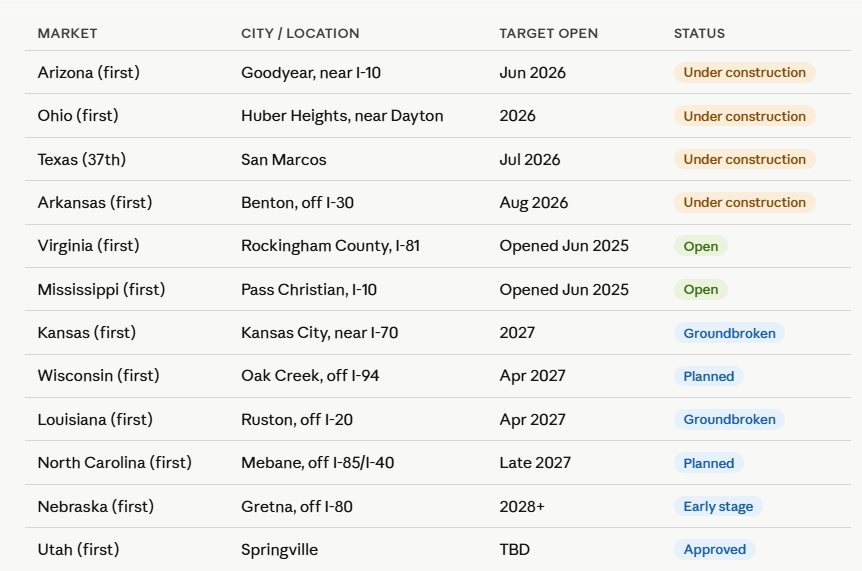
In 2025 alone, Buc-ee's broke ground across multiple new states in rapid succession. The pace of activity of six new states targeted in a single expansion wave signals a clear strategic inflection point for the brand. Here's where the growth is landing.
The Site Selection Science: Why These Corridors?

Buc-ee's site selection follows a consistent and disciplined logic. Every new location is anchored to a major interstate — I-10, I-40, I-80, I-94 — in communities where high-volume highway traffic intersects with business-friendly permitting environments and available land. The brand specifically seeks out underdeveloped commercial corridors where a single large-format anchor can catalyze surrounding development.
Stan Beard, Buc-ee's director of real estate and development, described the Ruston, Louisiana site as "a smart-growth town with a big attitude and the perfect location" — language that reveals the brand's dual calculus: strong existing traffic flow combined with a community eager for the economic lift a Buc-ee's brings.
Economic Ripple: More Than a Gas Station
The economic case for a Buc-ee's is unusually compelling for local municipalities. Each new travel center typically generates $30 million or more in annual sales, translating to significant sales tax revenue for host cities, in some cases representing a 30% or greater increase in a small town's total annual collections. Lafayette, Louisiana's second planned Buc-ee's carries an $82 million investment and is expected to bring 150 jobs by mid-2027. The West Memphis, Arkansas location on track to be the third-largest Buc-ee's ever built, is projected to create 225 jobs.
Beyond the headline numbers, each location functions as a commercial anchor. The Harrison County Development Commission in Mississippi has described its Buc-ee's as a "transformative project" likely to spur new development in hospitality, dining, and service industries nearby, a pattern playing out repeatedly across the expansion map.
What Makes the Model Work at Scale
For operators and site selectors tracking the convenience sector, Buc-ee's expansion offers a clear lesson in differentiation through scale and experience. While the broader industry races toward smaller formats and urban footprints, Buc-ee's has found its moat in going bigger — and making that bigness an experience in itself.
The Road Ahead: 20 States and Counting
With 17 confirmed locations in various stages of development and exploratory activity in states including Idaho, Indiana, and South Carolina, Buc-ee's trajectory points toward a national footprint of genuine scale. At roughly 55 operating locations today, the brand could realistically double its store count within this decade.
The northernmost push — to Oak Creek, Wisconsin — is particularly telling. Winter-weather markets represent a meaningful test of whether the Buc-ee's experience translates outside its Sun Belt comfort zone. If Wisconsin performs as expected, markets like Indiana, Nebraska, and the Mid-Atlantic become far more attainable at pace.
For retail real estate professionals and economic developers, the Buc-ee's expansion map is essentially a live case study in destination-driven site selection — proof that in an era of shrinking formats and digital disruption, scale and experience deployed at the right highway exit can still build something genuinely new.