Whether you're a local business owner, a national brand, or a media buyer, knowing exactly where to place your billboard in Atlanta can mean the difference between a campaign that converts and one that gets ignored. In this guide, MapZot.AI breaks down Atlanta's highest-traffic corridors, neighborhoods, and interchange hotspots, so you can make data-driven decisions for your out-of-home (OOH) advertising strategy.
Why Atlanta Is a Goldmine for Billboard Advertising
Atlanta is the economic engine of the Southeast. Home to nearly 6.2 million people in the greater metro area and headquarters to Fortune 500 giants like Coca-Cola, Delta Air Lines, and Home Depot, the city sees extraordinary daily traffic movement across its highways, arterials, and urban corridors.
Atlanta's sprawling geography also means that commuters spend an average of 60+ hours per year stuck in traffic, making billboard impressions some of the most captive, repeated, and high-value in the country. For advertisers, that's not a pain point, it's an opportunity. But not all billboard locations are created equal. Location intelligence platforms like MapZot.AI help advertisers identify the precise intersections, corridors, and zip codes that deliver the highest impressions per dollar, using real mobility data, traffic counts, and demographic overlays.
What Makes a Billboard Location "High-Value" in Atlanta?
Before diving into specific locations, it's worth understanding the criteria that make a spot worth your advertising budget:
Daily Traffic Volume (DTV): The number of vehicles passing a location daily. Atlanta's major interstates regularly exceed 200,000+ vehicles/day.
Dwell Time: How long drivers are exposed to the message. Stop-and-go traffic near interchanges increases exposure time significantly.
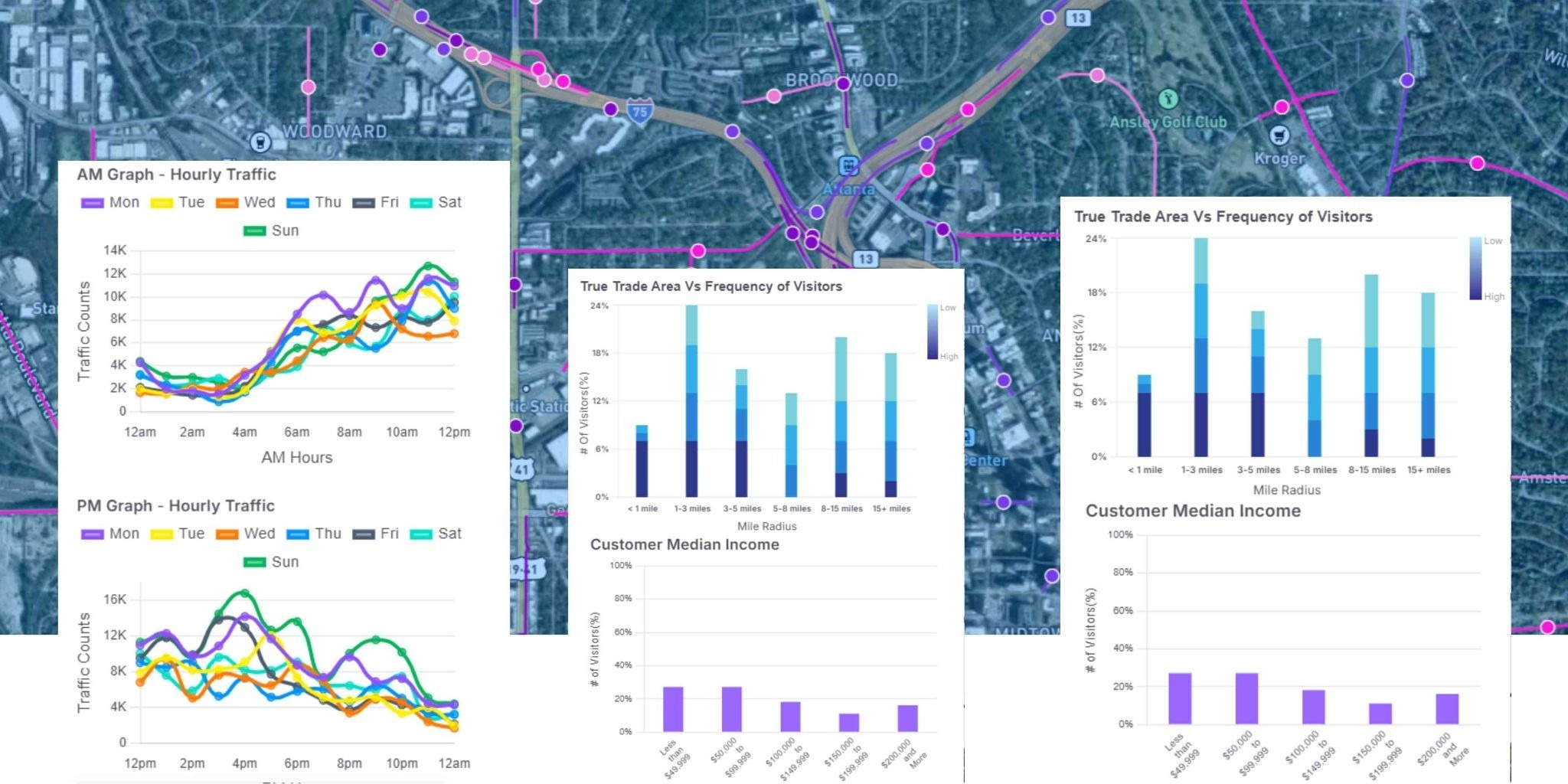
Audience Demographics: Income levels, age brackets, and consumer behaviors of the surrounding zip codes, available through MapZot.AI's audience intelligence layer. Visibility & Sight Lines: Distance from which the billboard is readable, unobstructed views, and whether it faces primary traffic flow.
Point-of-Sale Proximity: Billboards near retail clusters, restaurants, and shopping centers drive immediate action.
Top High-Traffic Areas in Atlanta
380K
Peak corridor
8
Total locations
150K
Avg daily traffic
Downtown Connector
360K
I-285 Perimeter
240K
GA-400 North
170K
I-20 East & West
130K
Airport Access
120K
Midtown Peachtree
100K
Buckhead
47K
Decatur / L5P
30K
Vehicles/day · GDOT estimates via MapZot.AI
1. I-285 (The Perimeter) — Atlanta's Busiest Ring Road
Average Daily Traffic: 200,000–280,000 vehicles
The I-285 loop encircles Atlanta and is the backbone of suburban commuter traffic. It connects every major suburb — Sandy Springs, Dunwoody, Smyrna, College Park — with the city core and Hartsfield-Jackson Atlanta International Airport.
Why it works for advertisers:
Massive, sustained exposure to a diverse commuter base
High household income in the northern corridor (Sandy Springs, Perimeter Center)
Heavy B2B traffic near the Perimeter Center business district
24/7 volume including airport-related travel
Best billboard positions: Northside near I-285/GA-400 interchange, and the I-285/I-85 South junction near the airport.
Best for: Financial services, luxury brands, corporate B2B, healthcare, travel & hospitality.
2. I-75/I-85 Downtown Connector — The Heart of Atlanta Traffic
Average Daily Traffic: 340,000–380,000 vehicles (one of the busiest urban corridors in the U.S.) Where I-75 and I-85 merge through downtown Atlanta, they form the "Downtown Connector" — arguably the single most trafficked stretch of highway in the entire Southeast. Billboards here command the highest CPM (cost per thousand impressions) in the market, and for good reason.
Why it works for advertisers:
Unrivaled daily volume — consistently ranked among the top 5 busiest urban corridors nationally Passes near Georgia State University, Mercedes-Benz Stadium, and CNN Center Massive event-driven spikes during Falcons, Atlanta United, and concert events Gateway to both Midtown and Downtown commercial districts
Best billboard positions: Northbound and southbound faces near the I-20 interchange and Spring Street exits.
Best for: Entertainment, sports brands, retail, consumer goods, restaurants, event promotions.
3. Midtown Atlanta (Spring Street & Peachtree Street Corridor)
Estimated Daily Footfall: 80,000–120,000 people
Midtown is Atlanta's cultural and creative hub — home to the High Museum of Art, Georgia Tech, Piedmont Park, and a dense concentration of young professionals, tech workers, and affluent residents. Peachtree Street billboards here benefit from both vehicular and heavy pedestrian traffic.
Why it works for advertisers:
Younger, digitally-native audience with high disposable income
Strong lifestyle and entertainment spending patterns
Adjacent to Atlanta's major employer cluster (tech, media, healthcare)
High repeat exposure from daily commuters and residents
Best billboard positions: Peachtree Street between 10th and 17th Street, and Spring Street near the I-75/85 on-ramps.
Best for: Tech brands, apps, fashion, lifestyle, food & beverage, healthcare, real estate.
4. GA-400 North Corridor — The Affluent Northern Suburbs Highway
Average Daily Traffic: 150,000–190,000 vehicles
GA-400 is the primary commute artery for some of Atlanta's wealthiest zip codes: Sandy Springs, Buckhead, Roswell, Alpharetta, and Johns Creek. This corridor delivers consistently high-income audiences who commute south toward Midtown and Buckhead for work.
Why it works for advertisers:
Top household income demographics in the metro area
Heavy morning and evening commuter flow is predictable and consistent
Proximity to Northpoint Mall and Avalon in Alpharetta — major retail anchors
Tech industry workers commuting from northern suburbs to Midtown
Best billboard positions: Near the Holcomb Bridge Road exit and the GA-400/I-285 interchange (known locally as "Spaghetti Junction North").
Best for: Luxury automotive, real estate, private schools, wealth management, premium healthcare, home improvement.
5. Buckhead — Atlanta's Luxury Commercial District
Average Daily Traffic (Peachtree Road): 40,000–55,000 vehicles
Buckhead is the Beverly Hills of Atlanta — an upscale neighborhood packed with luxury retail (Lenox Square, Phipps Plaza), fine dining, corporate offices, and high-rise residences. Billboard and large-format OOH inventory here is premium-priced and highly targeted.
Why it works for advertisers:
Highest median household income neighborhood in the city
Dense concentration of decision-makers, executives, and high-net-worth individuals
Foot traffic from Lenox Square (one of the top 10 most productive malls in the U.S.)
Luxury hotel district drives business traveler exposure
Best billboard positions: Peachtree Road near Lenox Square, and the Buckhead Loop (I-85 at Lenox Road exit).
Best for: Luxury goods, real estate, legal services, private banking, cosmetic services, premium automotive.
How MapZot.AI Helps You Find the Right Billboard Location
Manually researching traffic counts, demographic data, and OOH inventory availability is time-consuming and often inaccurate. MapZot.AI's location intelligence platform streamlines the entire process by giving advertisers:
Real-Time Traffic & Mobility Data, Actual movement patterns overlaid on every Atlanta corridor, so you're not relying on outdated DOT reports.
Audience Profiling by Location, Understand who's actually driving past a given billboard: their income, age, lifestyle, purchase intent, and brand affinity.
Competitive Conquest Mapping, See where your competitors are advertising in OOH and identify white-space opportunities.
Impression Forecasting, Predict how many unique and repeated exposures a billboard location will generate over your campaign window.
Multi-Market Scalability, Running campaigns across Atlanta, Charlotte, and Nashville simultaneously? MapZot.AI gives you a unified dashboard for the entire Southeast.
Final Thoughts: Data-Driven OOH Is the Future of Atlanta Advertising
Atlanta's billboard market is competitive, but it's also one of the most rewarding OOH markets in the country for brands that do their homework. The difference between a campaign that generates awareness and one that drives measurable business outcomes comes down to location precision, audience alignment, and data intelligence.
That's exactly what MapZot.AI was built to deliver.
Whether you're a media buyer optimizing a national campaign, or a local brand placing your first billboard in Atlanta, our platform gives you the intelligence to choose locations with confidence, not guesswork.